

Last updated: May 20, 2026 · Verified by YPA editorial · 6 sources cited
Fake cam model scams are harder to spot in 2026, but the fastest test is simple: ask the person to wave a hand slowly across half of their face. Real-time deepfake software can still break on partial occlusion, and a pre-recorded video loop cannot react at all. Combine that with reverse image search on the profile photo, and you catch most obvious fakes in under a minute.
This guide gives you a practical 60-second safety stack: what to test, what to ignore, and which old “red flags” no longer work in 2026.
Key takeaways:
- Real-time deepfake face-swap tools are now good enough to fake live video calls, according to Malwarebytes’ March 2026 report on AI-powered scam compounds.
- The FTC’s recent consumer guidance shows romance and deception scams remain a major financial risk for online users.
- Selfies and short clips no longer reliably confirm identity. Partial-face occlusion and live request-response checks work better.
- Big platforms such as Chaturbate, Stripchat, BongaCams, and LiveJasmin verify performers. Off-platform Telegram or WhatsApp redirects remove that protection.
- The safest rule is simple: test behavior before trusting appearance.
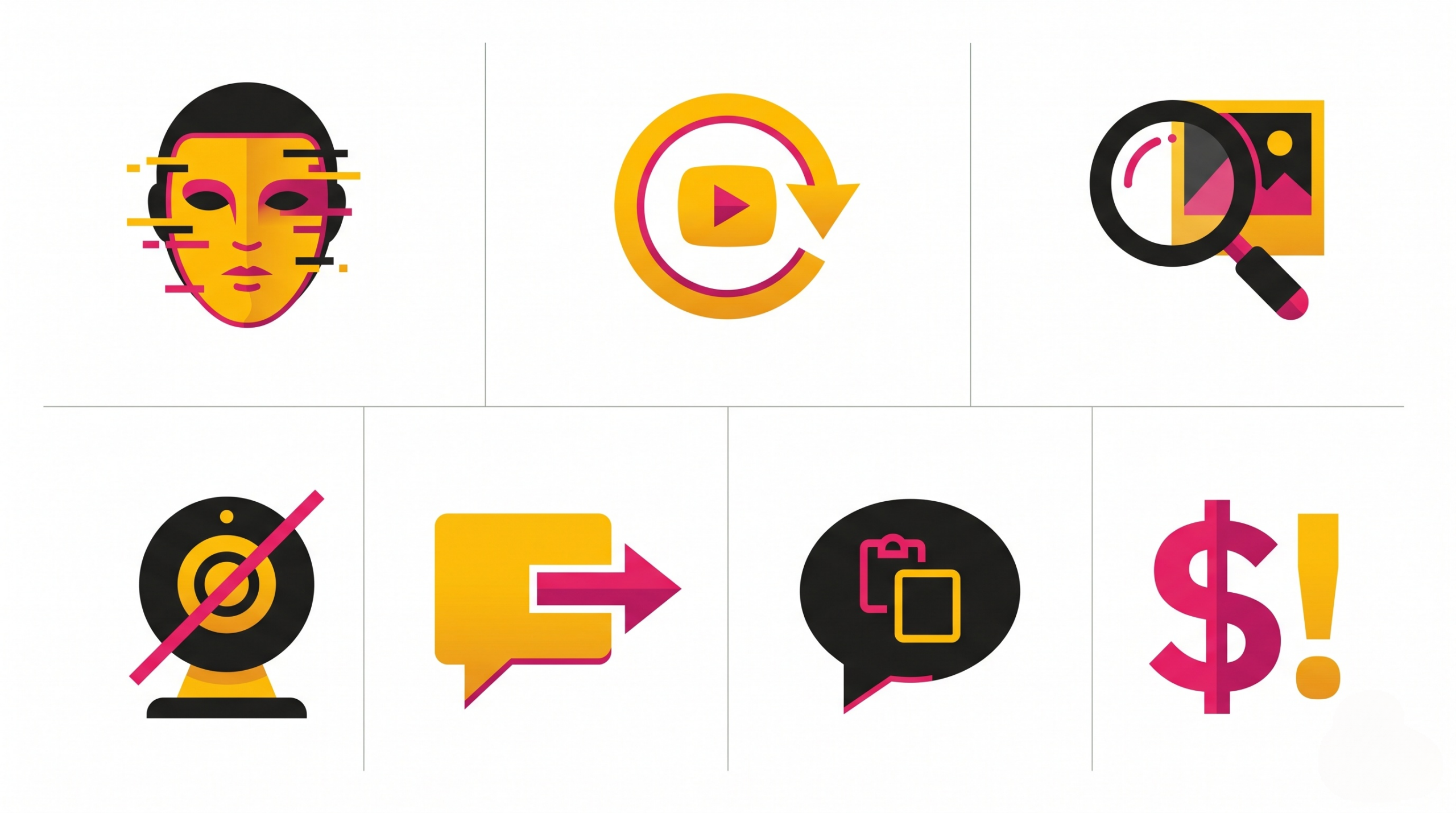
Quick comparison: 7 red flags and how to verify them
| Red flag | Detection method | Confidence |
|---|---|---|
| Suspected deepfake face-swap | Ask them to cover half the face with a hand for 5 seconds. | High |
| Pre-recorded video loop | Ask for a real-time gesture, such as 3 fingers up and then 2. | High |
| Reused stock or stolen photo | Use reverse image search via TinEye or Google Images. | High |
| “Camera broken” or typing only | Decline. Legit models on major platforms should be visible on cam. | High |
| Off-platform redirect | Refuse Telegram, WhatsApp, Snapchat or direct payment moves. | High |
| Generic copy-paste chat | Ask a specific time-bound question like “what time is it where you are?” | Medium |
| Aggressive tip pressure within 30 seconds | Cool off. Real performers earn over a session, not in seconds. | Medium |
Why fake cam models are harder to spot in 2026
Fake cam profiles used to be easy to catch. Bad English, blurry photos, recycled profile pictures, and refusal to go live were enough. That old checklist still helps, but it is no longer enough.
In 2026, the risk changed because the tools changed. AI face-swap software, voice cloning, pre-recorded video loops, romance-scam scripts, and off-platform payment funnels can now work together. A scammer does not need to look perfect. They only need to look real long enough to move you away from the platform and into a payment channel you cannot dispute.
That is why this guide focuses on behavior-based checks instead of appearance-based guesses. A fake can steal a photo. A fake can reuse a video. A fake can run a polished script. But a fake has a much harder time reacting naturally to specific live requests.
How we chose these 7 red flags
We picked these red flags using three practical filters:
- Fast: A normal user can run the check in under 60 seconds.
- Behavior-based: The test looks at live response, not just profile appearance.
- Platform-safe: The advice keeps users inside official cam platforms instead of pushing risky off-site contact.
This guide is written for adult webcam users who want to avoid fake profiles, AI-assisted scams, blackmail traps, stolen media accounts, and off-platform payment pressure. It is not about shaming real models or demanding invasive proof. The goal is simple: protect your money, privacy, and attention before you trust the wrong person.
The 7 real red flags of a fake cam model
1. The face breaks when a hand crosses it
The strongest deepfake test in 2026 is simple: ask the person to slowly move one hand across half of their face. A real person can do that instantly. A pre-recorded video cannot react. Some real-time face-swap systems can react, but many still glitch when the face is partly blocked by fingers, hair, glasses, shadows, or fast movement.
You are looking for strange warping around the eyes, mouth, jawline, or cheek. Watch for the face sliding, freezing, flickering, or briefly becoming blurry when the hand crosses it.
This test is not perfect, but it is much stronger than asking for a selfie. A scammer can steal a selfie. A live occlusion test forces real-time behavior.
YPA quick test: Ask: “Can you cover half your face with your hand for five seconds?” If they ignore it, joke around it, or immediately push you to tip first, treat that as a warning sign.
2. The video looks live, but never reacts to specifics
A fake cam model does not always need AI. Sometimes the scam is simpler: a pre-recorded video loop that looks like a live room. The profile may smile, move, adjust hair, or look toward the camera, but it never reacts correctly to what you say.
The easiest check is to ask for a specific, harmless, time-bound gesture. For example: “Can you hold up three fingers, then two?” or “Can you touch your left shoulder?” Real performers can do that naturally if they choose to. A loop cannot.
Do not overcomplicate this. You are not asking for anything invasive. You are checking whether the person is actually present.
Red flag: If every answer feels delayed, generic, or unrelated to what you asked, you may be watching a script or a loop, not a live model.
3. The profile photo appears somewhere else online
Stolen photos are still one of the easiest fake-profile signals. Before spending money, run a reverse image search on the profile picture. Use TinEye, Google Images, or another reverse image search tool.
If the same photo appears on unrelated dating sites, social profiles, escort spam pages, stock-photo websites, or old forum posts, stop. That does not prove every detail of the profile is fake, but it is enough to avoid paying.
Modern scammers often mix stolen photos with AI-generated variations, so reverse search is not a perfect test. Still, it catches enough obvious fakes to be worth doing.
4. The camera is always “broken” or never turns on
A fake cam model may claim the camera is broken, the connection is bad, the platform is glitching, or they can only type today. Once that happens, the situation stops being a cam interaction and becomes a trust game.
On real adult webcam platforms, the whole point is live video. A legitimate performer may have technical issues sometimes, but a profile that repeatedly avoids visible live interaction should not get your money.
This is especially important when the person asks you to move to another app. “My cam does not work here, message me on Telegram” is not a technical issue. It is a funnel.
Safe move: If the camera is not working, do not pay. Leave the room, choose another verified performer, and keep payment inside the platform.
5. They push you off-platform too fast
The most dangerous scams usually start when the conversation leaves the official platform. Telegram, WhatsApp, Snapchat, Cash App, gift cards, direct crypto payments, and “private VIP links” all remove the basic safety layer that official cam sites provide.
Major cam platforms can verify performers, process payments, enforce rules, and review disputes. Off-platform chats usually cannot. Once you send money outside the platform, getting it back is almost impossible.
This is also where sextortion risk can start. A scammer may ask for personal photos, cam-to-cam content, private usernames, email, or social profiles. Later, they can use that information to pressure you.
Red flag: If the person pushes you away from the official site before trust is established, assume the platform protection is the thing they are trying to escape.
6. The chat feels copy-pasted and avoids direct answers
Generic chat is not always a scam. Some models use templates because rooms move fast. The red flag is when the profile never answers specific questions and keeps steering the conversation back to payment.
Try a simple question that requires a current answer. Ask what time it is where they are, what song is playing, what color object is near them, or whether they can respond to something visible in the room. A real person may choose not to answer, but a fake script will usually dodge the question or reply with something unrelated.
Do not confuse language barriers with fraud. Many real performers speak English as a second language. Look for patterns: repeated lines, unrelated replies, sudden payment pressure, and refusal to respond to harmless live context.
7. They pressure you for money before anything feels real
Adult webcam platforms are paid entertainment. Asking for tips is normal. The red flag is aggressive payment pressure before you have seen enough to trust the room.
Fake profiles often try to create urgency: “tip now,” “private only,” “last chance,” “I will show you everything after payment,” or “send crypto first.” The goal is to make you act before you think.
A real performer can still be direct about pricing, but the room should make sense. You should be able to see the platform, read the tip menu, understand the rules, and decide calmly before spending money.
YPA rule: If the profile creates pressure faster than it creates trust, close the tab.
What changed from 2024 to 2026
Fake cam profiles did not disappear. They became more believable. The old version of the scam was simple: stolen photos, vague chat, a broken camera excuse, and a fast payment request.
The 2026 version can be more polished. A scammer may use AI-generated photos, voice tools, fake video-call clips, face-swap software, and more convincing scripts. Some scams now look less like spam and more like a real creator funnel.
| Signal | Old scam pattern | 2026 scam pattern | Better check |
|---|---|---|---|
| Profile photo | Obvious stolen image. | AI-edited or lightly altered image. | Reverse search plus behavior test. |
| Video proof | Low-quality reused clip. | Better loop or AI-assisted face overlay. | Ask for specific live movement. |
| Chat style | Broken English and obvious spam. | Cleaner scripts and AI-written replies. | Ask specific context questions. |
| Payment request | Direct wire, gift cards, or sketchy links. | Private crypto wallet, Telegram, fake VIP page. | Keep payment on official platform. |
The lesson is simple: appearance is easier to fake than behavior. A profile can look polished and still be unsafe. The best checks are live, specific, harmless, and hard to fake in real time.
What to do if you already paid a fake cam profile
If you already sent money to a fake profile, act quickly. Do not send more money to “unlock” content, remove threats, or prove trust. That is how the scam escalates.
- Stop paying immediately. Extra payments usually increase pressure instead of solving the problem.
- Screenshot everything. Save usernames, payment receipts, messages, links, wallet addresses, and profile URLs.
- Report the profile on the platform. Use the official report tool before the account disappears.
- Contact your payment provider. If you used a card, ask about dispute options. If you used direct crypto, recovery is usually much harder.
- Do not negotiate with blackmail threats. Save evidence and report threats through the relevant platform or local cybercrime channel.
If the scam involved threats, leaked personal information, or sextortion, treat it as a safety issue, not just an embarrassing mistake. The faster you stop responding and preserve evidence, the better.
FAQ
How can I tell if a cam model is fake?
The fastest practical check is live behavior. Ask for a harmless real-time action, such as covering half the face with a hand, holding up a specific number of fingers, or answering a current room-specific question. A real performer can respond naturally if they choose to. A fake profile, video loop, or scripted scam usually dodges the request.
Can deepfakes be used in webcam scams?
Yes. AI-assisted scams can now use face swaps, voice tools, fake video clips, and more believable scripts. That is why appearance alone is no longer enough. The safest checks are live, specific, and behavior-based.
Is a “camera broken” excuse always a scam?
Not always, but it is a strong warning sign if it happens repeatedly or comes with a request to move off-platform. If the person says the camera is broken and then asks for Telegram, WhatsApp, direct crypto, gift cards, or private payment, leave.
Should I talk to cam models outside the platform?
For safety, no. Official cam platforms give users basic protection: account rules, payment records, performer verification, and reporting tools. Off-platform chats remove most of that protection and are a common path into payment scams or blackmail attempts.
What should I do if I already paid a fake profile?
Stop paying immediately. Save screenshots, profile links, messages, wallet addresses, and payment receipts. Report the profile on the platform. If you paid by card, contact your payment provider. If there are threats or blackmail, preserve evidence and report the abuse through the relevant platform or local cybercrime channel.
Bottom line
The best way to spot a fake cam model in 2026 is not to judge beauty, accent, lighting, or profile polish. Those signals are too easy to fake. Watch behavior instead.
Ask for one harmless live action. Check the profile image. Refuse off-platform payment. Avoid anyone who creates pressure before trust. If something feels scripted, rushed, or strangely disconnected from the live room, leave.
For a safer starting point, use major platforms with performer verification and transparent user flows. You can also read YPA’s full adult webcam sites 2026 guide before choosing where to spend tokens or credits.
Sources and methodology
This guide is based on YPA editorial review of online scam patterns, adult-platform safety risks, deepfake detection concepts, and consumer protection guidance. We focused on practical checks that a normal user can run quickly without invasive demands or unsafe off-platform behavior.
- Malwarebytes: AI-models scam compounds and deepfake video-call scams
- Sardine AI: Deepfake detection overview
- FTC: Looking for love? Watch out for scammers
- FTC: What to know about romance scams
- DigitalForensics.com: Cam-girl sextortion risks
- McAfee: Deepfake scams and AI voice spoofing
Last updated: May 20, 2026. YPA reviews safety guides regularly as scam tactics, AI tools, and platform protections change.
About the author
YPA editorial team reviews adult-industry platforms with a focus on transparency, privacy, safe user experience, and clear monetization. Our goal is to help readers avoid confusing funnels, hidden costs, fake profiles and low-quality adult sites before they spend money.


