

Last updated: May 29, 2026 · Verified by YPA editorial · 9 sources cited
The fastest way to spot a rigged online casino in 2026 is to click the license badge in the footer. If it does not open a live page on the regulator’s official website with the casino’s exact operator name and valid license number, walk away.
That one check filters out many of the worst rogue operators before you even deposit. The rest usually fail one of six other structural tells: fake audit seals, unrealistic RTP claims, pending-forever withdrawals, escalating KYC demands, bonus terms with impossible wagering or support that disappears when you ask for your money.
Key takeaways:
- A real license badge clicks through to the regulator’s site and shows the specific operator by name with a license number.
- A real RNG audit seal from eCOGRA, iTech Labs or GLI links to a live certificate, not just the lab’s homepage.
- Average slot RTP is around 96%. Extremely high RTP claims without audit proof should be treated carefully.
- A withdrawal stuck in pending for more than 7 days is one of the clearest rogue-casino warning signs.
- Crypto-only casinos with no provably-fair system and no fiat fallback carry higher payment risk.
How to spot a rigged online casino: quick reference
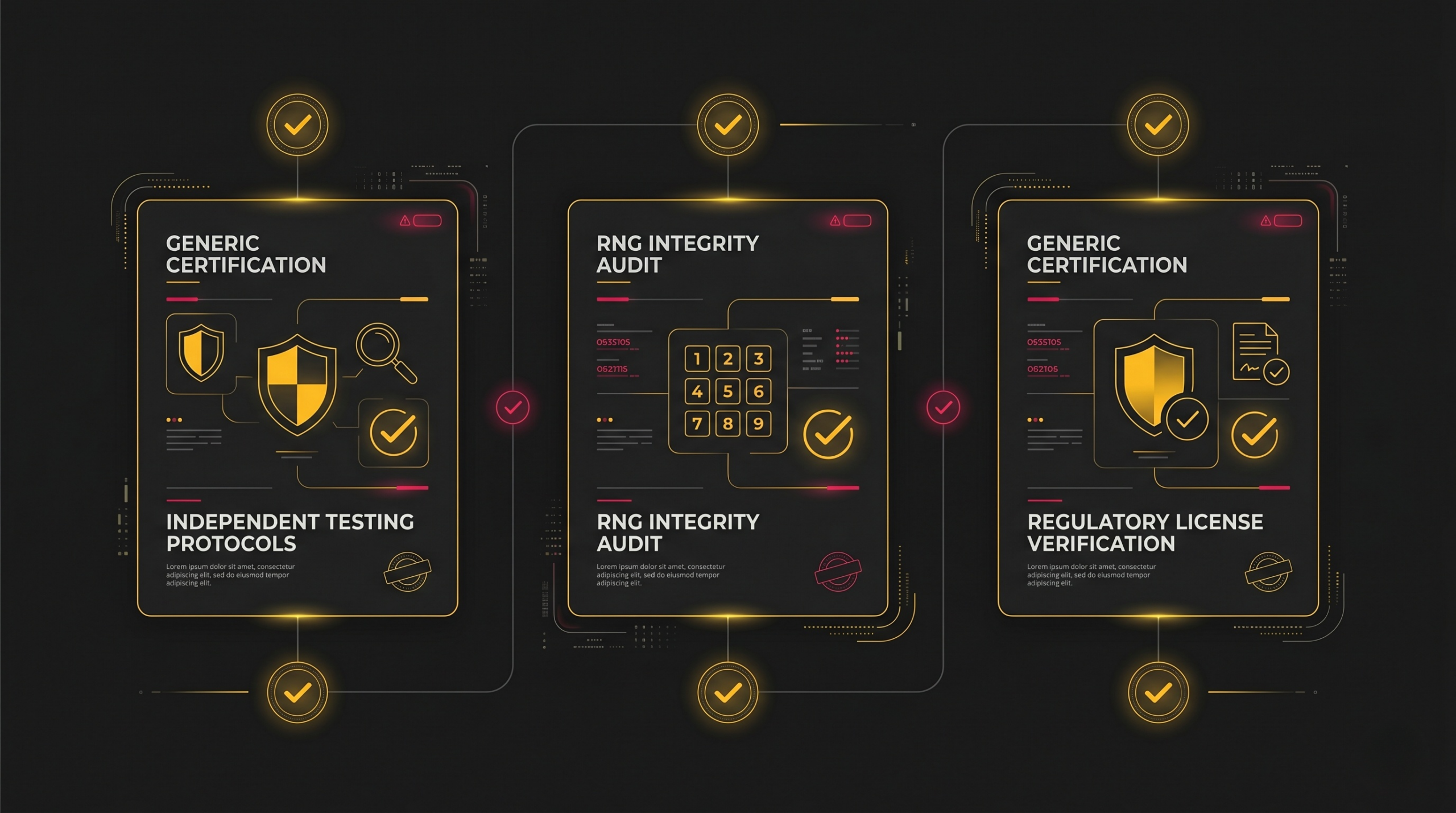
Why this matters in 2026
Online casino fraud is structurally different from random consumer fraud. In this case, the platform itself can be the bad actor. Independent blacklists such as LCB.org and Casino.org track operators flagged for non-payment, predatory terms, fake licensing or unsafe withdrawal behavior.
The most damaging pattern is not “your card got stolen.” It is this: you win fairly, request a payout and the casino quietly makes the money disappear through process abuse. The account stays open. Support keeps answering just enough to delay you. The withdrawal keeps sitting in pending. Then new document requests, bonus clauses or processor excuses appear.
Crypto-only casinos can increase that risk because crypto payments are hard to reverse once funds leave your wallet. This does not mean every crypto casino is bad. It means the license, audit and withdrawal checks matter more before you deposit.
YPA rule: A legitimate casino may be slow, but it communicates clearly, follows its published terms and resolves withdrawals within a defined timeframe. A scam casino creates open-ended barriers until you give up or deposit more money.
How we built this list
We assembled the seven red flags below from three practical source types: regulator license systems, independent RNG audit labs and public casino warning databases. The goal is not to guess whether a casino “feels shady.” The goal is to use checks a normal player can repeat in a few minutes.
- Regulator-published license verification systems from major gambling jurisdictions such as UKGC, MGA and Curaçao-style public registers.
- Independent RNG audit labs such as eCOGRA, iTech Labs and GLI.
- Industry blacklists and scam-pattern documentation from LCB.org, Casino.org, BitcoinChaser, Webopedia and Gambling Insider.
Every red flag below maps to a documented pattern that appears in current online casino complaints or blacklist documentation. We deliberately exclude vague signs like “the site looks ugly” or “support sounded strange.” Those may matter, but they are not strong enough by themselves.
The 7 red flags
Red flag #1: The license badge does not actually verify
A legitimate online casino displays a license badge in the footer linking to its regulator’s website. The destination should be a live official page showing the specific casino or operator by name with a current license number. It should not be a generic homepage, a dead link or a static badge image.
Failure modes that mean serious risk:
- The badge is not clickable.
- The badge links to a generic regulator homepage.
- The badge opens a 404 page.
- The regulator site does not show the casino or operator name.
- The license appears suspended, expired or attached to a different operator.
UKGC and MGA both publish public registers. A basic register lookup is one of the strongest free checks you can do before depositing.
Red flag #2: The RNG audit seal links to nowhere
Random Number Generator audits help prove that game outcomes are statistically fair and that payouts match the advertised RTP range. Three major testing names in the sector are eCOGRA, iTech Labs and GLI. A real audit seal should lead to a live certificate or verification page, not just a decorative image.
A fake audit seal is usually static. It may show a lab logo but link nowhere. In other cases it links to the lab homepage instead of a certificate for the exact casino or software version. That is not enough.
The critical caveat: certificates can become outdated when games or software versions change. A casino using an old certificate from years ago without current coverage is not the same as an actively certified casino.
Red flag #3: Unrealistic RTP claims
The average online slot RTP is around 96%. Some individual games may be higher, but those are specific titles with specific published rules. If a casino advertises “98.5%+ RTP across most games” or “highest RTP in the industry” without per-game evidence or audit references, treat the claim carefully.
What a legitimate RTP claim looks like: the RTP is shown on the game information page and supported by the game provider or audit documentation. Anything vague like “competitive payouts” or “best odds online” is marketing, not proof.
Red flag #4: Withdrawals stay pending for more than 7 days
Slow withdrawals are not always fraud. Some casinos process cash-outs manually, some payment rails take longer and some accounts need compliance review. The red flag is not one slow day. The red flag is a withdrawal that stays pending with vague explanations, repeated delays or no clear deadline.
A pattern seen across rogue-casino complaints is “process abuse.” The casino does not simply refuse to pay. It keeps the request alive while adding friction: new document requests, processor excuses, bonus-term disputes, account reviews or silence from support.
What to do: before depositing, search the casino name plus “withdrawal pending,” “not paying,” “blacklist” and “complaints.” If the same complaint pattern appears across multiple sources, do not treat it as bad luck.
Critical warning: A casino that is fast to accept deposits but vague on withdrawals is not a casino problem. It is a risk model.
Red flag #5: KYC appears only after you win
Know Your Customer checks are normal in regulated gambling. A legitimate casino may ask for identity documents, proof of address or payment verification. The warning sign is timing and escalation.
If a casino accepts deposits without friction but suddenly demands endless documents only after you win, that can become a payout-delay tactic. One document becomes three. Then a selfie. Then a notarized copy. Then proof of funds. Then “management review.” The issue is not KYC itself. The issue is using KYC as an open-ended excuse to delay or cancel withdrawals.
What to check: read the KYC policy before depositing. A serious casino explains when verification is required, which documents are accepted and how long review normally takes.
Red flag #6: Bonus terms make winning almost impossible
Some bonuses are fair. Some are traps. The most dangerous bonus terms are not always obvious in the headline offer. “500% welcome bonus” can sound exciting while the actual terms make withdrawal nearly impossible.
Watch for very high wagering requirements, max-bet traps, game contribution exclusions, short expiry windows and confusing withdrawal caps. A 100x+ wagering requirement can turn a bonus into a mathematical obstacle rather than a real benefit.
Simple rule: if you cannot explain the bonus terms in one minute, do not claim the bonus. Deposit without a bonus or choose a clearer casino.
Red flag #7: Crypto-only setup with no provably-fair system
Crypto casinos can be legitimate, but the risk profile is different. Crypto payments are generally irreversible, wallet addresses are easy to spoof and some operators use crypto-only setups to avoid traditional payment accountability.
A stronger crypto casino should explain its license, withdrawal rules, KYC policy and whether games are independently audited or provably fair. If a casino accepts only crypto, shows no license, provides no audit proof and offers no provably-fair verification, the player carries most of the risk.
If you are comparing deposit rails, read our guide to Bitcoin vs USDT casino deposits. Payment method choice cannot fix a rigged casino, but it can reduce fee and delay problems on legitimate platforms.
YPA rule: Crypto is a payment tool, not a trust signal. A bad operator can accept crypto just as easily as a good one.

What to do before you deposit
Before you deposit at a new online casino, do not start with the welcome bonus. Start with verification. A safe-looking homepage is easy to design. A verifiable license, current audit certificate and clean withdrawal reputation are harder to fake.
Use this quick stack before putting money in:
- Click the license badge and confirm the exact operator on the regulator’s website.
- Click the RNG audit seal and confirm it opens a live certificate or verification page.
- Search the casino name with “blacklist,” “not paying,” “withdrawal pending” and “complaints.”
- Read the bonus terms before claiming any promotion.
- Check whether the withdrawal page explains limits, timeframes and KYC requirements clearly.
- Make a small test deposit and small test withdrawal before committing a larger bankroll.
Best default: If the license, audit and withdrawal rules are not easy to verify, do not deposit. A real casino does not make basic trust checks difficult.
What to do if you already deposited
If you already deposited and something feels wrong, stop adding money. Rogue casinos often try to make the player chase the withdrawal with more deposits, more bonuses or more “verification” steps.
Take screenshots of your account balance, withdrawal request, bonus terms, KYC requests, support messages and transaction IDs. If the casino is licensed, contact the regulator or dispute-resolution channel listed on the regulator’s official page. If you used crypto, save the transaction hash and wallet address.
Also search public complaint databases and casino warning lists. A single complaint is not always proof. A repeating complaint pattern is much stronger evidence.
FAQ
How can I tell if an online casino is rigged?
The fastest check is the license badge. Click it and confirm that it opens a live official regulator page showing the casino’s exact operator name and license number. Then check the RNG audit seal, withdrawal reputation and bonus terms.
Are all unlicensed casinos rigged?
No, not every unlicensed casino is automatically rigged, but the risk is much higher. If there is no verifiable license, no independent audit and no clear withdrawal policy, you have very little protection if the casino refuses to pay.
Can a casino fake an RNG certificate?
Yes. A rogue casino can place a static audit logo in the footer without a valid certificate behind it. A real seal should click through to a live certificate or verification page connected to the casino or software provider.
Is a crypto casino more likely to be rigged?
Not automatically. Crypto is only a payment method. The real question is whether the casino has verifiable licensing, independent game testing, clear withdrawal rules and a provably-fair system where relevant.
What is the biggest red flag before depositing?
The biggest red flag is a license badge that does not verify on the regulator’s official website. If the site cannot prove who regulates it, every other claim becomes weaker.
Bottom line
Spotting a rigged online casino is less about guessing whether the games “feel fair” and more about checking the structure around the casino. A legitimate operator makes license, audit, withdrawal and bonus rules easy to verify.
A rogue operator does the opposite. It hides behind static badges, vague licenses, unclear RTP claims, slow withdrawals, sudden KYC barriers and bonus terms that only appear after you try to cash out.
If you want a safer starting point, use the YPA gambling directory, compare payment methods in our Bitcoin vs USDT casino deposit guide and apply the same safety mindset we use in our adult dating app safety guide.
Sources and methodology
This guide is based on public casino-warning databases, RNG certification documentation, crypto-casino scam coverage and current gambling safety research. We focused on checks that a normal player can repeat before depositing.
- eCOGRA RNG certification
- LCB.org casino warnings
- Casino.org untrustworthy casinos
- Webopedia crypto casino scams guide
- Gambling Insider online casino scams
- BitcoinChaser bitcoin casino scams
Last updated: May 29, 2026. YPA reviews casino safety guides regularly as licensing rules, crypto-payment risks and rogue-operator patterns change.
About the author
YPA editorial team reviews adult-industry platforms with a focus on transparency, privacy, payment risk, user safety and clear user experience. Our goal is to help readers avoid confusing funnels, hidden costs, fake trust signals and unsafe platforms before they spend money or share personal information.


