

Leaving an adult platform is usually three separate jobs: stopping future charges, closing the account, and asking what happens to the personal data already collected. Finishing one does not prove that the other two are complete.
The short answer: cancel, close, then check the data
- Cancel the paid plan or recurring billing. Save the confirmation and the date on which paid access ends.
- Close the platform account. Record whether the profile is hidden, deactivated, or permanently closed.
- Use the privacy route for personal data. Ask what will be deleted, what may be retained, why it may be retained, and which outside processors received it.
Do these in that order when a live subscription exists. Deleting an account first can remove the dashboard or support history you need to prove a cancellation.

Three actions, three different outcomes
| Action | Main job | Useful confirmation | What it does not prove |
|---|---|---|---|
| Cancel billing | Stop the next recurring charge or end a paid plan at the stated date | Cancellation reference, end date, final amount, and merchant or billing operator | That the profile is closed or stored personal data is erased |
| Close the account | End access to the login, profile, or service account | Closure email, ticket number, effective date, and stated account status | That an outside subscription is cancelled or every record is deleted |
| Request data deletion | Ask the organisation to erase eligible personal data under the applicable route | Scope of request, response, retained categories, reason, and completion date | Immediate removal of every record in every jurisdiction or backup |
1. How to cancel an adult subscription without losing your records
Start with the transaction, not the profile. Find the exact subscription, renewal interval, next charge date, cancellation route, and company or processor that appears on the payment record. A platform name and the billing operator can be different.
The US Federal Trade Commission advises people to follow the company's cancellation instructions, keep a copy of the request, watch later card or bank statements, and save related records. That is useful process guidance, not proof that every platform follows the same rule or that the same remedy applies worldwide.
Save these details
- the plan name and renewal interval;
- the cancellation path you used;
- the confirmation number or message;
- the date paid access ends;
- the merchant or billing operator;
- the last expected charge and any stated refund position.
A removed payment card is not a cancellation record. A deleted app is not a cancellation record. A support chat that says the issue is being reviewed is not a completed cancellation unless the service confirms the outcome.
2. Find out whether the account is hidden, deactivated, or closed
Account language matters. Hide profile, pause, deactivate, and close account may produce different outcomes. Read the exact wording before you confirm the action.
Before closing the login, download any receipts, cancellation records, support messages, or creator tax and payout documents that you are entitled to keep. Do not collect other people's private material. The goal is to preserve your own transaction and support record.
Ask one precise question
If the interface is vague, ask the official support route: Does this action permanently close my account, and does it affect any subscription managed by a separate billing provider?
Keep the answer with its date and case reference.
3. Treat personal data as a separate request
Closing a login does not automatically explain what happens to identity records, age-assurance results, payment records, messages, uploads, support tickets, device data, or information held by processors. Open the current privacy notice and look for the controller, request route, data categories, purposes, recipients, and retention language.
Deletion rights depend on the law and the facts. The UK Information Commissioner's Office explains that people can ask an organisation to erase personal data in certain circumstances, but the right is not absolute. An organisation may retain some information when an exemption or another legal obligation applies. This UK example should not be presented as a universal rule.
Age checks add another question: did the platform make the decision itself, or did a third-party provider process the proof? Ofcom's 2026 age-assurance report says services should conduct due diligence on vendors and comply with privacy and data-protection obligations. The European Commission's current age-verification approach also treats privacy-preserving proof of age as a design requirement. Neither source proves how a particular platform handles a particular person's data.
A bounded request is easier to verify
Name the account identifier and the categories you want addressed. Ask the organisation to confirm:
- which personal data will be erased;
- which personal data will be retained;
- the reason and expected period for retention;
- whether processors or other recipients were notified;
- whether a separate age-assurance provider holds related data;
- the route for a follow-up or complaint.
Use the official domain or contact route. Do not send identity documents through an unsolicited message, social-media reply, or address that you cannot independently connect to the service.
What a useful completion record looks like
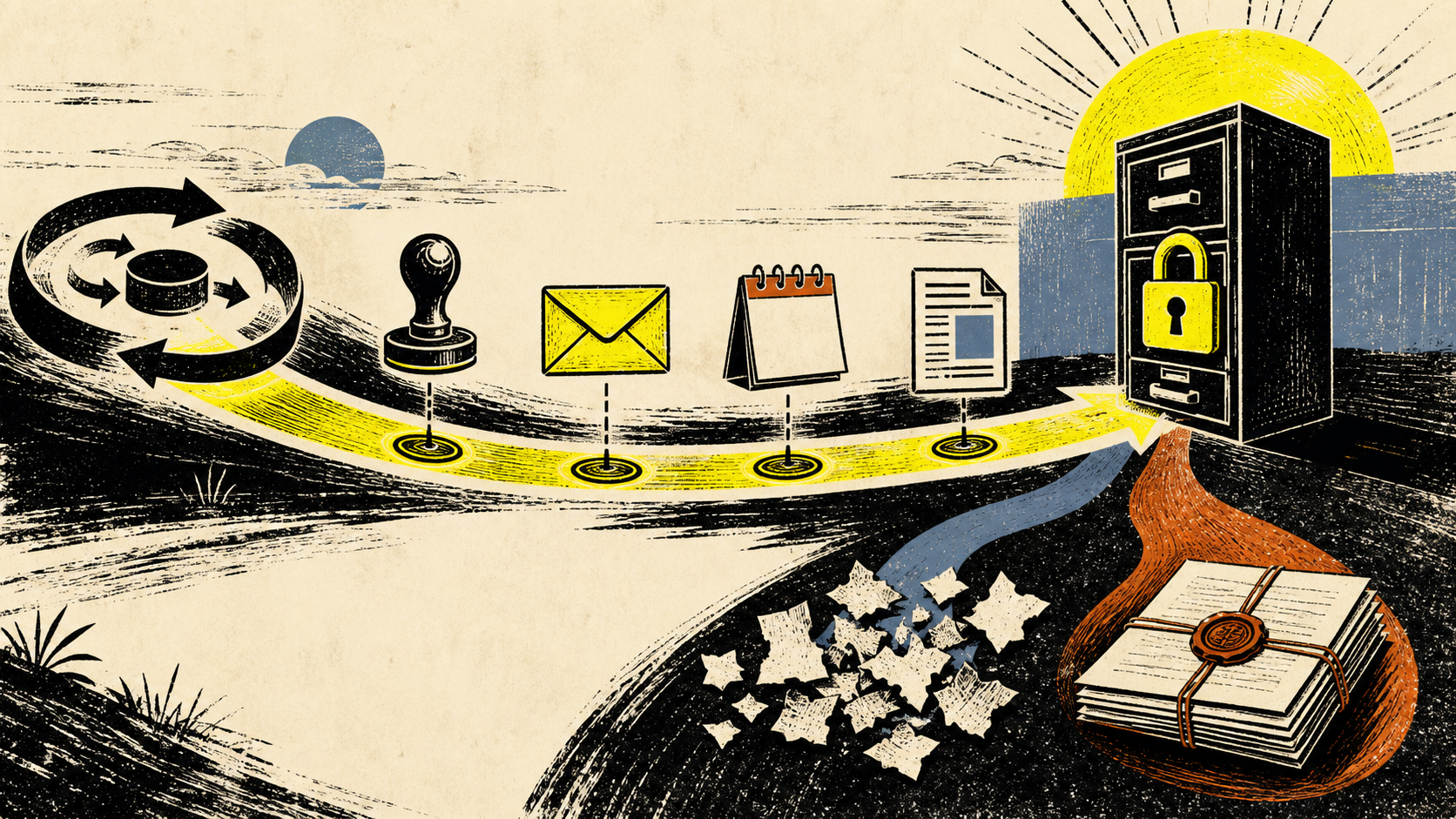
A strong exit record is boring and specific. It has dates, reference numbers, the legal or billing entity, and the scope of what changed. It does not depend on a disappearing success screen.
- Capture the offer and renewal terms that applied to your plan.
- Save the cancellation confirmation outside the platform inbox.
- Record the final access date and check later statements.
- Save the account-closure confirmation and exact status.
- Keep the data request, response, and any stated retention exceptions together.
Do not publish receipts, account IDs, identity documents, billing descriptors, or private support messages just to prove that you completed the process.
If the exit route is missing or does not work
Stay inside official channels and separate the problem by layer. A billing problem goes to the documented billing or subscription route. An account-access problem goes to account support. A data-rights request goes to the privacy contact or controller named in the current notice.
Record the date, URL, error, and response. If charges continue after a documented cancellation, contact the card or bank provider through the trusted contact details on your statement or card. The available dispute and complaint routes depend on your country and payment method, so use the relevant local consumer or data-protection authority when needed.
Five exit shortcuts that are not enough
- Deleting the app: removes software from a device, not necessarily the subscription or account.
- Removing a card: changes a payment method, not necessarily the agreement to renew.
- Hiding the profile: changes visibility, not necessarily account status or data retention.
- Unsubscribing from email: changes marketing messages, not the paid plan or stored account data.
- Seeing a success screen: is weaker than a saved confirmation that names the action and effective date.
When the honest answer is UNKNOWN
A public terms page can document what a company says. It cannot prove that a cancellation worked for your account, that every processor erased data, or that no record remains. If the service does not publish a clear route or does not answer a bounded request, the result is UNKNOWN, not automatically safe and not automatically fraudulent.
Yellow Pages Adult separates published evidence from tested outcomes. Read the YPA methodology, review the site's Privacy Policy, and use the Corrections Policy to report a material error.
Questions people ask when leaving a platform
Does deleting an account cancel a subscription?
Not necessarily. Confirm the subscription state and billing operator before you remove access to the account dashboard.
Does cancellation delete personal data?
Not necessarily. Cancellation addresses future paid service. Data deletion or erasure is a separate question governed by the current privacy route and applicable law.
Should I remove my payment method first?
Use the documented cancellation route first and save proof. Removing a payment method by itself may not end the underlying agreement.
How long does data deletion take?
There is no universal timeline. The answer depends on jurisdiction, request scope, verification needs, processors, backups, and any valid retention basis. Ask for the applicable response period and a completion record.
Sources and scope
- US Federal Trade Commission: free trials, auto-renewals, cancellation, and recordkeeping, checked 9 August 2026.
- UK Information Commissioner's Office: the public right-to-erasure guide, checked 9 August 2026.
- Ofcom: Use of Age Assurance Report 2026, checked 9 August 2026.
- European Commission: the EU approach to age verification, checked 9 August 2026.
Scope: this is general educational information for adults. It does not provide legal advice, certify a platform, or establish the outcome of an account, payment, or data request.


