

Last updated: August 14, 2026 | Checked against 6 primary public sources | Yellow Pages Adult Editorial Team
Before you upload ID to an adult site, identify the company running the check, learn whether the site receives your document or only an over-18 result, find the retention period and confirm a deletion or correction route. If any answer is missing, stop at the upload screen and ask before sending anything.
Key takeaways
- An age check does not always require the adult site to receive your name, document number or exact birth date.
- UK and European privacy guidance stresses purpose limitation, data minimisation and retention limits even when age assurance is mandatory.
- A separate verification provider can reduce what the destination sees, but only the current privacy notice explains the actual flow.
- A promise such as “we do not store your ID” is incomplete unless it identifies who processes the file and what derived data or logs remain.
- No checklist proves that a service is safe. It helps you spot unanswered questions before the irreversible step.
The 30-second decision
| What you can confirm before upload | What to do |
|---|---|
| Provider, data requested, recipients, retention and deletion route are all named | Continue only if the method and trade-off are acceptable to you |
| The site offers a threshold token or another lower-data method | Prefer the option that discloses only what the check needs |
| The notice says “secure” or “not stored” but omits the processor or retention details | Pause and ask for the missing specifics |
| The upload opens an unexplained domain, email request or messaging app | Stop and verify the route through the site’s official support channel |
| No usable privacy notice, contact or alternative exists | Do not upload until the service answers the gap |
Why this matters in 2026
Age checks are no longer an edge case. Ofcom says UK services that allow pornography must use highly effective age assurance where the Online Safety Act applies. Its framework looks for technical accuracy, robustness, reliability and fairness, while privacy and data-protection obligations continue to apply.
The European direction is also moving away from unnecessary identity disclosure. The European Commission’s age-verification blueprint is designed so an online service can receive an anonymous proof that a person is over a threshold without receiving the person’s identity details. As of April 2026, the Commission described the app as technically ready with national availability still developing.
The useful question is not only “Does this prove I am 18?” It is also “Who learns what about me while it happens?”

How to upload ID to an adult site with less exposure
1. Name every company in the verification chain
Look at the upload screen, privacy notice and linked terms. Write down the adult site, the age-verification provider and any processor that receives the image, selfie, bank result or device data.
Do not assume a familiar logo tells you which legal entity handles the file. If the notice refers only to “our trusted partners,” the chain is not yet clear enough to evaluate.
2. Separate the input from the result
A provider may inspect a passport and selfie, but the destination might receive only an over-18 result. Another design may send identity fields or a persistent account attribute to the site.
Ask two different questions: what does the verifier collect, and what does the adult site receive? The EDPB says providers should process only age-related attributes that are strictly necessary for the stated purpose. It gives a tokenised threshold result as an example of minimisation.
3. Check whether a lower-data method exists
Ofcom lists several methods that can be capable of highly effective age assurance, including open banking, photo-ID matching, facial age estimation, mobile-network checks, credit-card checks and digital identity services. It does not approve a single provider for everyone.
The most private option is not automatically the easiest or most accurate option. Compare what each available method collects, what the site receives and whether the method works in your location.
| Method shown by a service | Data that may enter the process | Question to ask before choosing it |
|---|---|---|
| Photo-ID matching | Document image, document fields and a live face image | Is the document deleted after the match, and what derived result remains? |
| Facial age estimation | A face image or short capture plus an estimated age result | Is the image retained or used to improve a model? |
| Open banking or bank-based proof | Account-holder or age-related confirmation through a bank flow | Does the adult site receive only a threshold result? |
| Mobile-network check | Confirmation tied to the mobile account or network | What identifier connects the result to this visit? |
| Digital identity or age token | A credential or threshold proof | Is the proof single-use, reusable or linkable across services? |
These are questions, not claims about every implementation. Read the notice attached to the method you actually see.
4. Find the retention period before the upload
“We do not store your ID” can still leave open whether a third party stores it, whether a face template remains or whether transaction logs connect the check to an account. Look for separate retention periods for the source image, extracted fields, biometric template, threshold result and technical logs.
The ICO says personal information should not be kept longer than necessary and notes that a service may need to retain only a yes/no output after a check. If the page provides no duration or deletion trigger, ask for one.
5. Find the deletion and correction route
A useful notice identifies who handles privacy requests, the information needed to locate a record and the jurisdiction that governs the request. Save the notice URL and the date before you upload because policies and vendors can change.
Deletion is not always immediate or absolute. Legal retention duties, fraud controls or disputes may affect the outcome. The goal is to know the route and its stated limits before your data enters the system.
6. Verify the upload destination
Open the privacy link from the age-check screen and compare its domain with the provider named in the notice. If the flow moves to a different domain, confirm that the new domain is disclosed. Do not send identity documents through an unexpected email address, direct message or support chat merely because someone says it will be faster.
This check cannot prove that a page is secure. It can catch a mismatch between the stated process and the page asking for the file.
7. Test the support route with one precise question
Ask a question that cannot be answered with generic reassurance: “After verification, which party keeps my document image, face capture and over-18 result, and for how long?”
A useful answer separates those data types and names the responsible company. A reply that repeats “bank-grade security” without answering retention or recipients leaves the original decision unresolved.
What a privacy-preserving result can look like
The European Commission’s blueprint illustrates one possible architecture. A trusted source issues an age proof, the link to the source data is cut and the online service receives an anonymous threshold proof rather than identity details. The issuer is not meant to learn which service receives the proof.
That model is a benchmark, not a description of every adult-site check. A commercial flow may use different providers, identifiers and retention rules.
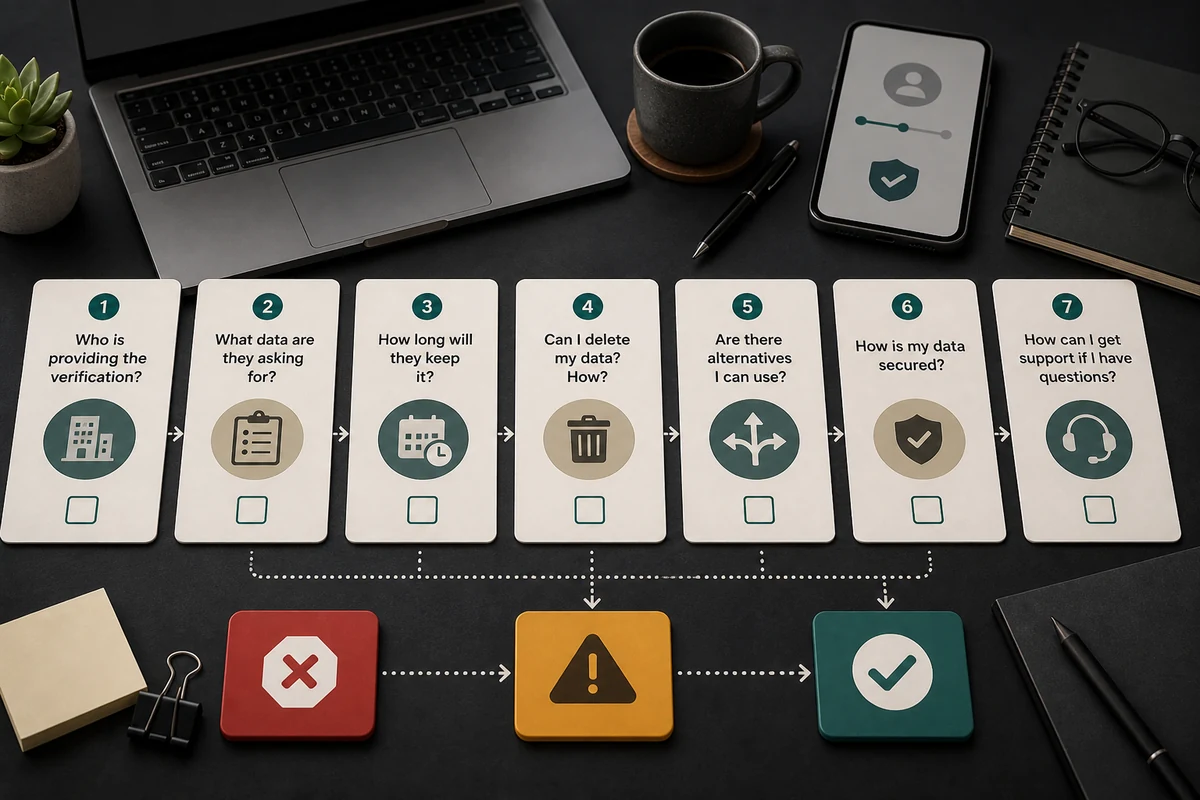
Seven red flags that justify a pause
- The upload page does not identify the verifier.
- The privacy notice never says whether the adult site receives the document or only a result.
- The process requests an exact identity field without explaining why a threshold result is insufficient.
- Retention is described as “as long as necessary” with no criteria or data-specific explanation.
- No correction, deletion or privacy-contact route is visible.
- The upload moves to an undisclosed domain or informal messaging channel.
- Support answers a retention question with security marketing instead of a duration and responsible entity.
One red flag does not prove misconduct. It means the user still lacks information needed for an informed choice.
If you already uploaded your ID
Save the provider name, date, method and privacy-notice URL. Ask the site and verifier which data they hold, their retention period, the recipients and the process for correction or deletion.
If the response indicates a breach or misuse, follow the complaint route in the applicable privacy notice and contact the relevant regulator for your jurisdiction. YPA cannot determine your legal rights from the upload screen alone.
FAQ
Does an adult site need my full ID to prove I am over 18?
Not necessarily. Some methods use a document or bank relationship during verification but give the destination only an age-threshold result. The correct answer depends on the service, provider, jurisdiction and method. Check what the verifier collects separately from what the adult site receives.
Is facial age estimation more private than uploading a passport?
It can expose different data, not automatically less risk. Facial age estimation may avoid document fields but still processes a face image and an inferred age. Ask whether the image is retained, whether a reusable template is created and whether the capture is used for model improvement.
Does “we do not store your ID” mean nothing is retained?
No. The statement may refer only to the adult site or only to the original image. A provider could retain a result, template or technical log. Look for the responsible companies and separate retention periods for source files, derived data and transaction records.
Can incognito mode protect an ID upload?
Incognito mode changes some local browser history and session behavior. It does not change what the age-check provider receives, what the adult site receives or how either company retains submitted data. Treat browser privacy and identity-processing privacy as separate decisions.
Should I use a VPN to avoid an adult-site age check?
This article does not provide bypass instructions. Age-assurance duties and access rules vary by location, and Ofcom tells regulated services not to encourage circumvention. Evaluate the available lawful method and its privacy terms instead.
Bottom line
Before sending identity data, make the service answer seven concrete questions: who verifies, what enters the process, what reaches the site, how long each data type remains, how deletion works, whether a lower-data method exists and where support is accountable. A polished upload screen is not a substitute for those answers.
YPA records unknowns instead of guessing. Read our methodology, corrections policy and affiliate disclosure for the standards behind this guide.
Sources and methodology
- Ofcom, Age assurance duties under the Online Safety Act. Checked August 14, 2026.
- Ofcom, Quick guide to implementing highly effective age assurance. Checked August 14, 2026.
- ICO, Expectations for age assurance and data protection compliance. Checked August 14, 2026.
- European Data Protection Board, Statement 1/2025 on Age Assurance. Checked August 14, 2026.
- European Commission, Blueprint for an age-verification solution. Updated April 29, 2026; checked August 14, 2026.
- European Commission, Common approach for EU-wide age-verification technologies. Published April 29, 2026; checked August 14, 2026.
Commercial disclosure: this article contains no affiliate destination links and does not recommend an age-verification vendor.


