

Last reviewed: June 22, 2026 · Last updated: June 22, 2026 · YPA editorial
Provably fair is an approach that lets you check a game result yourself using cryptography, rather than relying only on the operator’s word. In a typical setup, the casino commits to a secret value before the round, mixes it with an input you control, and reveals the secret afterward so you can recompute the result. A correctly implemented commit and reveal system can let a player check whether the revealed server seed matches the commitment that was published before the result was generated. It is a useful transparency tool, but a narrow one. It can provide additional transparency for the specific result generation process that its verifier covers, and nothing more. It does not show that a casino is safe, licensed, reliable to withdraw from, or good value. This guide explains the mechanism, how to verify a result, and where the guarantees stop.
What provably fair means
The idea rests on a standard cryptographic tool called a commitment scheme. A commitment lets one party lock in a value while keeping it hidden, then reveal it later so the other party can confirm it was the same value. By the standard model, a commitment has two properties: hiding, meaning the locked value stays secret until it is opened, and binding, meaning the committer cannot open it to a different value afterward. When a commitment is built from a collision resistant hash function, the binding property follows, because producing a second valid opening would mean finding a hash collision.
Provably fair applies this pattern to game outcomes. The operator commits to a secret seed before you play, you add your own input, and after the round the operator reveals the secret so you can recompute. If the revealed seed matches the earlier commitment and the shown outcomes follow from the agreed inputs, you have checked that part of the process yourself.
The three inputs: server seed, client seed, nonce
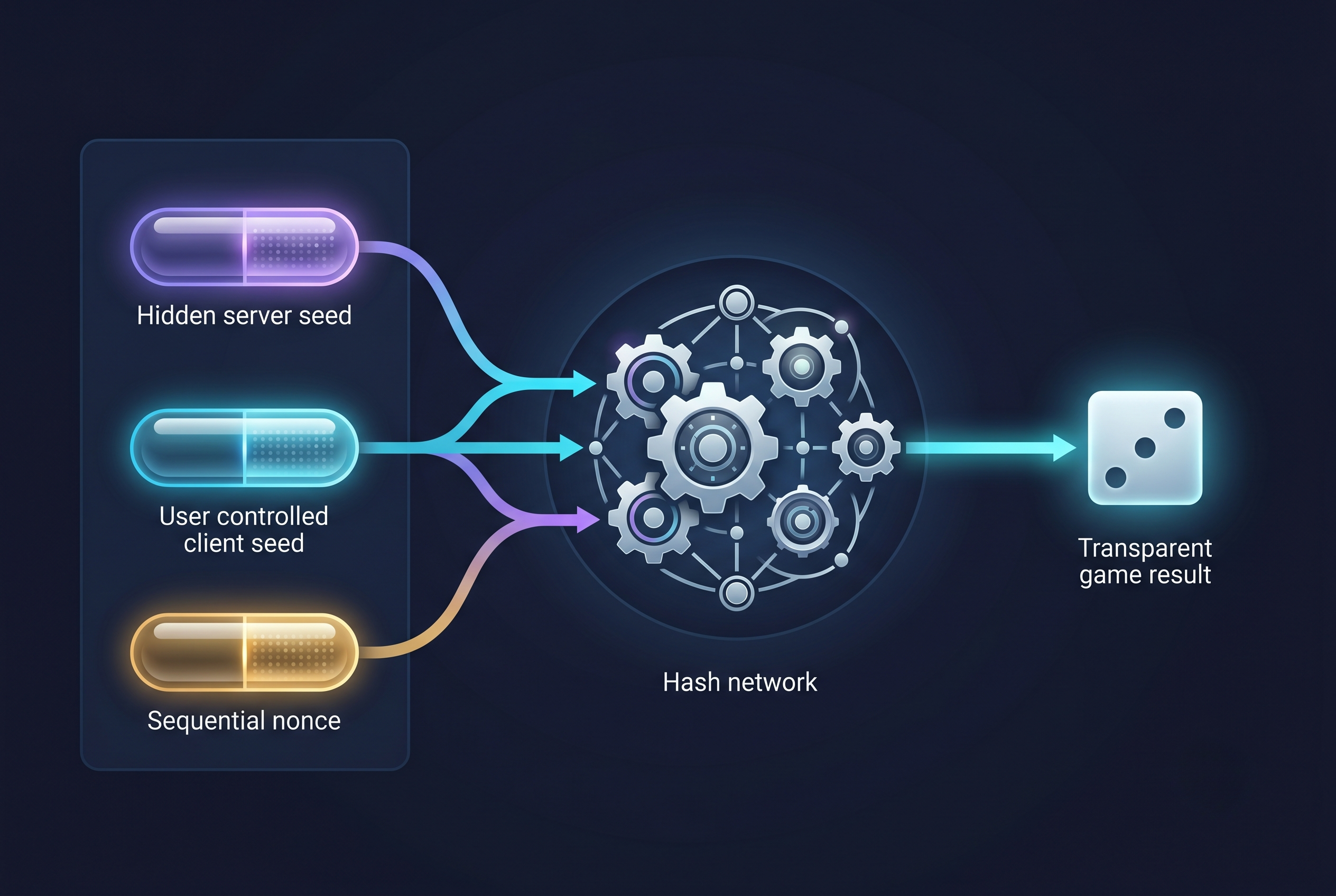
Many provably fair systems use three values. The exact names, order, and handling vary between operators and games, so treat this as a common pattern rather than a fixed standard.
Server seed. A secret random string the operator generates. Before you play, the operator shows only a hash of this seed, not the seed itself. That hash is the commitment.
Client seed. An input on your side that you can usually view and change. Because you control it, the operator cannot know the full set of inputs in advance.
Nonce. A counter that increases by one for each bet under the same seed pair, so repeated bets do not repeat results.
Hash commitment, in plain terms
The hashed server seed shown before play is the commitment. A cryptographic hash turns any input into a fixed length digest and is one way, so seeing the hash does not reveal the seed, which gives hiding. Because a strong hash is collision resistant, the operator cannot later present a different seed that produces the same hash, which gives binding. The hash functions commonly used here, such as SHA-256, are defined in the US federal Secure Hash Standard, NIST FIPS 180-4, whose stated purpose is to generate digests that detect whether data has changed [FIPS 180-4]. When the seed is later revealed, you re hash it and check it against the commitment you were shown.
How a result is produced
After the inputs are set, a common implementation runs them through a keyed hash, often HMAC with SHA-256, then converts the output into a game number. HMAC is the keyed hashing construction defined in RFC 2104 [RFC 2104], and HMAC-SHA-256 specifically, along with public test vectors that implementations can check against, is specified in RFC 4231 [RFC 4231]. A pattern some operators use looks like this:
HMAC_SHA256(server_seed, client_seed + ":" + nonce)
The hexadecimal output is then mapped into the range a game needs, for example a dice roll or a card position. This is one common example, not a universal standard. The exact inputs, their order, any cursor used to read more bytes, and the final conversion differ between operators and between games, which is why a verification script usually has to match the specific site.
How to verify a result, step by step
- Before betting, record the hashed server seed the operator shows you. This is the commitment to check later.
- Set or note your client seed. Many sites let you type your own.
- Play, and note the nonce for the rounds you want to check.
- Rotate the seed pair. Verification is only possible after you retire the current server seed, because that is when the operator reveals it. Revealing it earlier would expose upcoming outcomes.
- Re hash the revealed server seed and confirm it equals the commitment from step 1. If it does not match, the operator did not honor its commitment.
- Recompute each outcome using the revealed server seed, your client seed, and each nonce in the same algorithm, then convert to the game result and compare with what you saw.
You can use the operator’s own verifier or an independent one. An independent verifier is more convincing, because it does not depend on the operator’s code. Public test vectors for HMAC-SHA-256 in RFC 4231 let a developer confirm that a verifier computes the keyed hash correctly [RFC 4231].

A conceptual example
Suppose an operator picks a secret server seed and publishes its SHA-256 hash before you play. You set your client seed. For bet number one, the result is derived from the keyed hash of the server seed with your client seed and the nonce one. For bet number two, only the nonce changes to two, producing a different value. When you finish, you rotate your seeds and the operator reveals the original server seed. You re hash it and confirm it equals the hash you were shown at the start, which shows the seed was fixed before you played. You then recompute the bets and compare. No money figures are needed to follow this, because the point is the verification flow, not any specific win or loss.
How this compares to other fairness approaches
Provably fair is not the only model. Many conventional online casinos instead rely on random number generators that are checked by external parties rather than by the player. The practical difference is who does the checking. With provably fair, the player can check individual results without trusting anyone. With externally tested systems, the player relies on the testing party. Both models exist in the market. This article does not assess any specific regulator, laboratory, or certification, and the presence of provably fair on a site is not by itself a statement about external testing or licensing.
What provably fair covers, and what it does not
A scope limit worth knowing: in many implementations, provably fair applies to an operator’s own in house games, such as its dice, crash, or mines titles, while third party slots and live dealer games are handled differently and may not be individually verifiable by you in the same seed and nonce way. This varies by operator, so check which specific games expose a verifier before assuming the whole catalog does.
Provably fair, even when correctly implemented, confirms only part of the result generation process. By itself it does not show any of the following:
- That the casino is safe to use.
- That the casino is licensed or legal in your location.
- That withdrawals are reliable or paid on time.
- That the return to player or house edge is favorable. A result can be fully verifiable while the game still has a high house edge.
- That your privacy is protected. Privacy depends on an operator’s data and identity practices, a separate question covered in our guide to no-KYC crypto casinos.
- That bonus terms, such as wagering requirements, are reasonable.
Keep these separate. A provably fair label is one signal about result integrity, not a verdict on the operator. For broader warning signs that a casino may be untrustworthy, see our guide on how to spot a rigged online casino.
Red flags of a fake or weak implementation
- No hashed server seed is shown before you play, so there is no real commitment.
- You cannot view or change your client seed.
- The site never lets you rotate seeds or never reveals the old server seed, so you can never verify.
- Only a closed operator tool exists, with no documented method to recompute independently.
- The site advertises provably fair but exposes a verifier for no actual games.
- The published method is too vague to reproduce a result.
Practical verification checklist
- Hashed server seed shown before play: yes or no.
- Client seed visible and editable: yes or no.
- Seed rotation available and old server seed revealed afterward: yes or no.
- A documented method you can reproduce: yes or no.
- An independent verifier usable, not only the operator’s: yes or no.
- Which specific games expose a verifier, and which do not.
If the first four are not all yes, the provably fair claim is weak in practice.
Frequently asked questions
What does provably fair mean? It means you can check, with cryptography, whether a revealed server seed matches a commitment published before the round, and whether the shown result follows from the agreed inputs. It covers result generation, not the wider business.
How can I verify a result myself? Record the hashed server seed before playing, set your client seed, rotate seeds so the server seed is revealed, re hash it to match the original commitment, then recompute each outcome with the same algorithm.
Is provably fair the same as a tested random number generator? No. Externally tested systems rely on a third party doing the checking. Provably fair lets you check individual results yourself. They place trust differently.
Does provably fair change the RTP or house edge? No. It addresses how a result is generated and revealed, not the payout structure. A verifiable game can still have a poor return to player.
Can a casino be provably fair but still have problems? Yes. Provably fair says nothing on its own about licensing, withdrawals, privacy, or safety.
How do I spot a real verifier instead of marketing language? Look for a documented, reproducible method, an editable client seed, seed rotation that reveals the old server seed, and ideally an independent verifier rather than only the operator’s tool.
Methodology
This explainer describes the standard cryptographic building blocks behind provably fair and a common way operators combine them. The hashing and keyed hashing primitives are taken from primary specifications: HMAC from RFC 2104, HMAC-SHA-256 and its test vectors from RFC 4231, and SHA-256 from NIST FIPS 180-4. The commitment idea follows the standard hiding and binding model. The specific seed and nonce arrangement is an application pattern that varies between operators, not a single standard, so the formula shown is an example. We did not run or test any casino system, and nothing here endorses any operator.
Honest caveat
Provably fair can provide additional transparency for the specific result generation process that its verifier covers. It does not speak to the trustworthiness of the business behind it. Use it as one input among several, confirm which games actually expose a verifier, and never treat a provably fair label as proof that a casino is safe, legal, or worth your money. For more crypto gambling guides and casino listings, see our gambling directory.
References
- RFC 2104, HMAC: Keyed-Hashing for Message Authentication (IETF, 1997)
- RFC 4231, Identifiers and Test Vectors for HMAC-SHA-256 and others (IETF, 2005)
- FIPS 180-4, Secure Hash Standard (NIST, 2015)
About the author
The YPA editorial team reviews adult and gambling platforms with a focus on transparency, safety, and honest limits. We separate what a feature actually proves from how it is marketed.


