Last updated: June 28, 2026 · Reviewed by YPA editorial · 4 sources cited
RTP explained simply: return to player is the theoretical percentage of total wagers a casino game returns over the long run, while house edge is the percentage it retains mathematically. A 97% RTP equals a 3% house edge, but it does not mean a single $100 session will return $97. Short-term results can land far above or below that number because variance dominates small samples.
Key Takeaways
- RTP is a long-run average, not a promise for one session.
- House edge equals 100% minus RTP.
- 97% RTP equals a 3% theoretical house edge.
- Variance and volatility shape short-term results.
- Provably fair and high RTP are different concepts.
A high RTP lowers theoretical long-run cost. It does not make a short gambling session predictable.
What Does RTP Mean?
RTP stands for return to player. It is the theoretical percentage of total money wagered that a game returns as prizes over a statistically significant sample.
The UK Gambling Commission explains that RTP is calculated across a large number of games and does not describe what happens during an individual play or session. A game advertised at 97% RTP is designed to return approximately $97 from every $100 wagered across the long run, not from each separate player deposit.
What Is House Edge?
House edge is the operator’s theoretical long-run margin. It is calculated by subtracting RTP from 100%.
For example:
- 97% RTP = 3% house edge
- 96% RTP = 4% house edge
- 94% RTP = 6% house edge
The house edge is not a fixed charge removed from every session. It is the mathematical advantage expected to emerge across repeated play.
RTP vs House Edge
| Metric | What It Means | Example | What It Does Not Mean | How to Use It |
|---|---|---|---|---|
| RTP | The long-run share of total wagers returned as prizes | 97% RTP returns about $97 per $100 wagered across a large sample | It does not promise $97 back from one $100 session | Compare similar games by theoretical long-run cost |
| House Edge | The operator’s theoretical long-run margin | 97% RTP equals a 3% house edge | It is not a fixed fee charged to each session | Read it as expected long-run cost, not a session prediction |
Why 97% RTP Is Not $97 Back
The most common RTP misunderstanding comes from confusing a deposit with total wagering volume.
Imagine you deposit $100 and continue betting with both the original balance and any small returns. By the end of the session, you may have placed $1,000 in total wagers even though you deposited only $100.
With a 3% theoretical house edge, $1,000 of turnover represents an expected long-run cost of about $30. That does not mean your session will lose exactly $30. The actual result can be a profit, a smaller loss or a complete loss.
| Example | Amount | What It Means |
|---|---|---|
| Deposit | $100 | The money initially added to the account |
| Total Wagers | $1,000 | The total turnover after repeatedly recycling the balance |
| 3% House Edge | About $30 | The expected long-run cost across repeated comparable play, not a prediction for one session |
Why RTP Needs a Large Sample
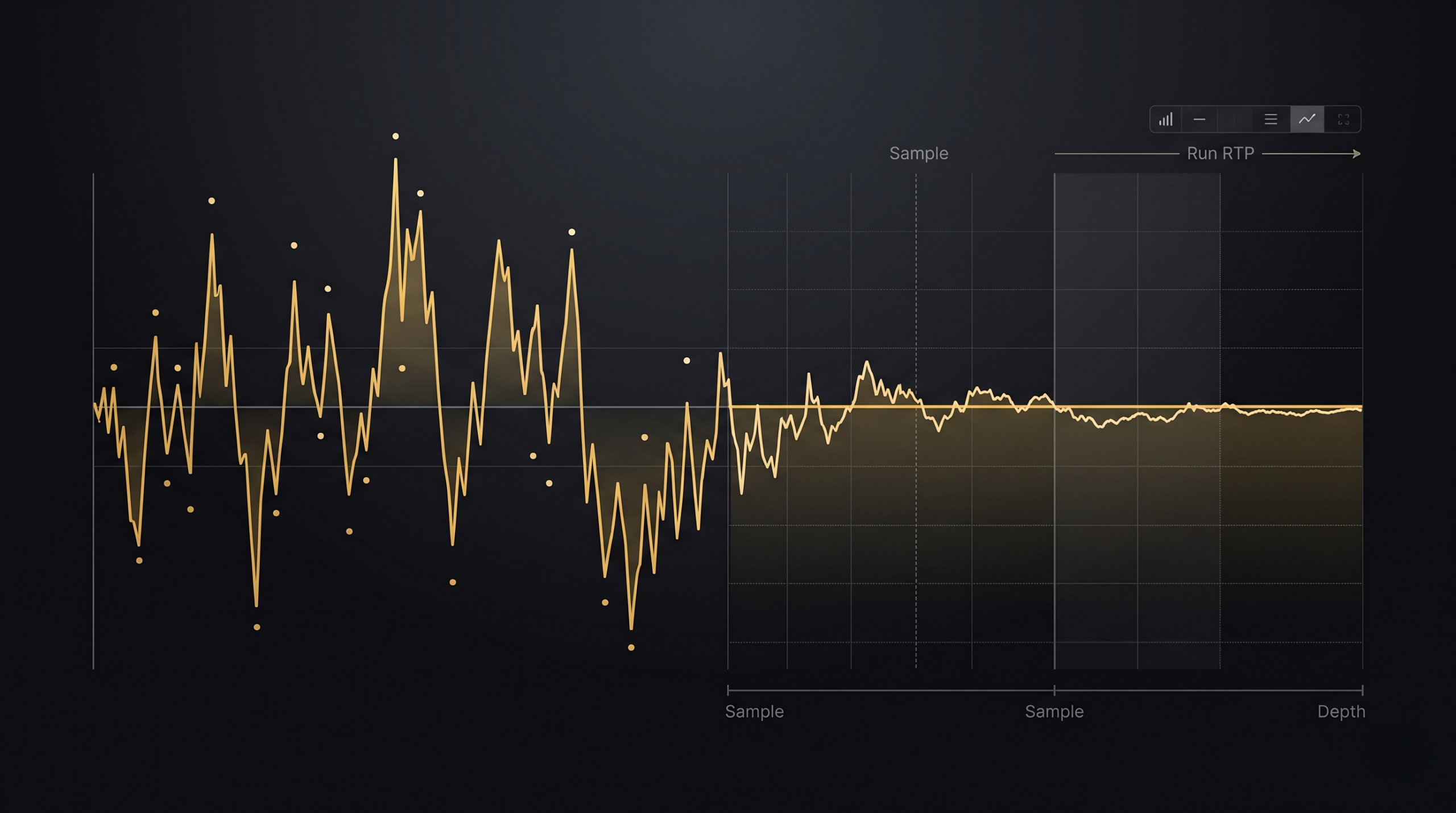
RTP becomes informative only across a sufficiently large number of plays. A few hundred or even a few thousand spins may still produce a return far above or below the advertised percentage.
A 96% RTP game can generate a strong short-term profit for one player and a steep loss for another. Neither result contradicts the game’s long-run mathematics.
Variance and volatility are related, but they are not identical.
Variance is the statistical measure of how widely outcomes can spread around the expected average. Volatility is the practical label used to describe how intense those swings feel during play.
A low-volatility game tends to distribute smaller wins more frequently. A high-volatility game tends to concentrate more of its return into less frequent larger outcomes.
Two games can have the same 96% RTP while creating completely different experiences. One may produce frequent small returns while the other may remain quiet for long stretches before a larger result.
Hit Frequency vs RTP
Hit frequency measures how often any winning result appears, regardless of its size. It does not measure long-run value.
A game can show a winning result frequently while still returning less money overall because many of those wins are smaller than the amount staked. Another game may hit less often but award larger prizes.
A higher hit frequency may make play feel more active, but it does not guarantee a longer session, a better return or a profit.
RTP vs Provably Fair
RTP and provably fair answer different questions.
- RTP describes theoretical long-run payback.
- Provably fair can help verify that a specific result was generated from committed cryptographic inputs.
A provably fair game can still carry a large house edge. Verifiable does not automatically mean generous.
For a complete explanation, read our guide to provably fair casinos.
Can Casinos Change RTP?
Different approved RTP versions of the same game may exist across operators. A provider may offer higher and lower approved configurations while keeping the graphics and core game features largely unchanged.
In regulated environments, approved configurations are tested and are not meant to be altered during active play. Where a game provides an information or help screen, check the RTP shown there rather than relying only on a review or promotional page.
A lower published RTP is not automatically evidence of manipulation. Our guide on how to spot a rigged online casino explains the difference between an unfavourable published configuration and stronger warning signs.
Common RTP Myths
| Myth | Reality |
|---|---|
| 97% RTP returns $97 from every $100 session | RTP is a long-run average across total wagers. One session can return far more or far less. |
| High RTP means you will probably win | A 97% game still carries a 3% theoretical house edge. |
| RTP predicts session length | Session length also depends on stake size, bankroll, volatility and player decisions. |
| Provably fair means high RTP | Provably fair addresses result verification. RTP is a separate game setting. |
| High RTP removes variance | A high-RTP game can still produce long losing stretches and sharp balance swings. |
High RTP vs Low RTP
| Factor | Higher RTP: 97% | Lower RTP: 94% |
|---|---|---|
| Theoretical Return | About $97 per $100 wagered over the long run | About $94 per $100 wagered over the long run |
| House Edge | 3% | 6% |
| Short-Term Predictability | Low | Low |
| Relationship to Volatility | None by itself | None by itself |
| Player Takeaway | Lower theoretical cost across repeated play | Higher theoretical cost across repeated play |
A higher RTP is preferable when two games are otherwise comparable because it lowers theoretical long-run cost. It does not make an individual session predictable.
How to Use RTP in Practice
- Check the game’s own information screen. Do not rely only on third-party reviews.
- Compare similar games. RTP is most useful when other features are broadly comparable.
- Check volatility separately. RTP does not describe how sharp the swings may be.
- Consider total turnover. Repeated wagering can make total stakes much larger than the original deposit.
- Set spending and loss limits. A high RTP does not remove the mathematical advantage.
If a bonus is involved, wagering rules may matter as much as the game’s RTP. Read our guide to casino wagering requirements for a full explanation.
Frequently Asked Questions
Does 97% RTP mean I get $97 back?
No. It means the game is designed to return about 97% of total wagers across a large sample. One $100 session can return much more or much less.
Is a higher RTP always better?
For theoretical long-run cost, yes, when other factors are equal. A higher RTP leaves a smaller mathematical margin with the operator. It does not guarantee a winning session.
What is the difference between RTP and volatility?
RTP describes theoretical long-run payback. Volatility describes the intensity and pattern of short-term swings. Two games with the same RTP can have very different volatility.
Does provably fair mean a game has better RTP?
No. Provably fair can help verify result integrity. RTP and house edge are separate settings.
Can a casino lower a game’s RTP?
Different approved RTP configurations of the same game may exist across operators. Check the game’s information or help screen to see the version shown for the game you are using.
Does high RTP cancel variance?
No. RTP is a long-run average. Variance describes short-term dispersion. A high-RTP game can still produce sharp losses.
Responsible Play
No RTP below 100% makes repeated gambling mathematically profitable. Treat gambling as paid entertainment and use only money you can afford to lose.
Set spending limits before playing, avoid chasing losses and take a break when gambling stops feeling optional. Support services such as GamCare and the National Gambling Helpline offer confidential help.
Final Verdict
RTP is useful because it reveals the theoretical long-run cost of a game. House edge shows the same relationship from the operator’s side.
Neither number predicts one session. Variance, volatility, stake size and total turnover can dominate short-term results. Use RTP to compare similar games, verify the displayed percentage where possible and never treat a high RTP as a promise of winning.
Sources and Methodology
- UK Gambling Commission: Return to player and machine payouts
- UK Gambling Commission: Return to player and game performance
- Wikipedia: Return to player
This article explains RTP, house edge, variance and volatility using regulator guidance and standard gambling mathematics. Monetary examples are rounded and illustrative. We did not test a specific casino or game configuration.
About the Author
The YPA editorial team reviews adult and gambling platforms with a focus on transparency, practical risk and honest limits. We separate what a metric actually proves from how it is marketed.
Editorial framework reviewed June 2026. This article provides general educational information, not betting or financial advice.